One experience across a multi-framework platform
Structural standards that let independent product teams at an insurance provider ship one coherent ecosystem across legacy and modern stacks.
- Client
- Insurance provider
- Role
- UX architect
- Timeline
- Mar 2026 – now
- Scope
- Internal and external products, legacy and modern frameworks
Screens
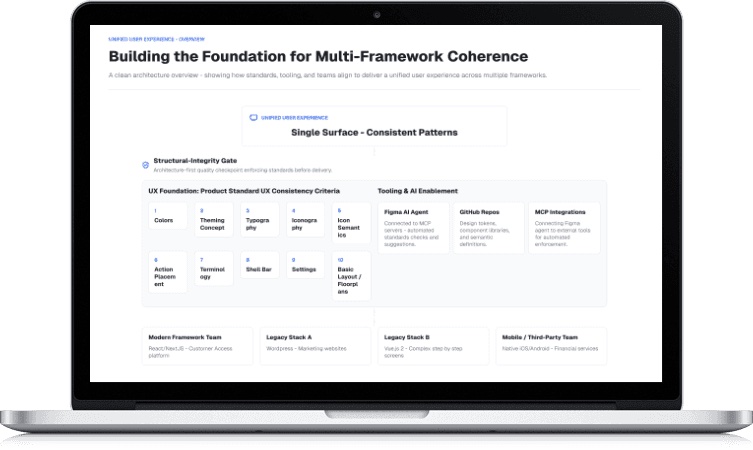
Problem
- A large ecosystem of internal and external products on legacy code, several modern frameworks and conflicting ways of working.
- Teams worked in silos, so products did not fit together, visually or structurally.
- The insurance domain demands structural integrity across deep data entry and complex policy workflows.
Role
- Ecosystem orchestrator: sets the structural standards every product team builds on.
- Lead for AI best practices across teams.
Decision
- Mandatory standards over suggested guidelines. With heavy technical debt and many frameworks, guidelines were ignored or misread.
- A floor of structural standards (core logic and information architecture every product must follow) keeps the experience coherent. Teams stay free to solve their own product problems on top of it.
Research
- Cross-team audit of interaction patterns across legacy and modern stacks to find where the user journey breaks.
- Framework interoperability mapping: how each stack can support shared standards without rewriting legacy code.
- Experiments with LLM-based tools to find where AI speeds up documentation and prototype logic the most.
Results
- A shared structural foundation that makes independent products read as one ecosystem.
- Central AI best practices cut manual documentation and sped up the handoff from structure to engineering.
- A structural-integrity gate for cross-product work: no new features on top of unresolved information architecture debt.
- Teams now apply the standards themselves instead of depending on one person.
Reflection
- UX architecture in a complex enterprise is not a visual skin. It is the structural floor that lets many teams move fast without breaking the whole.